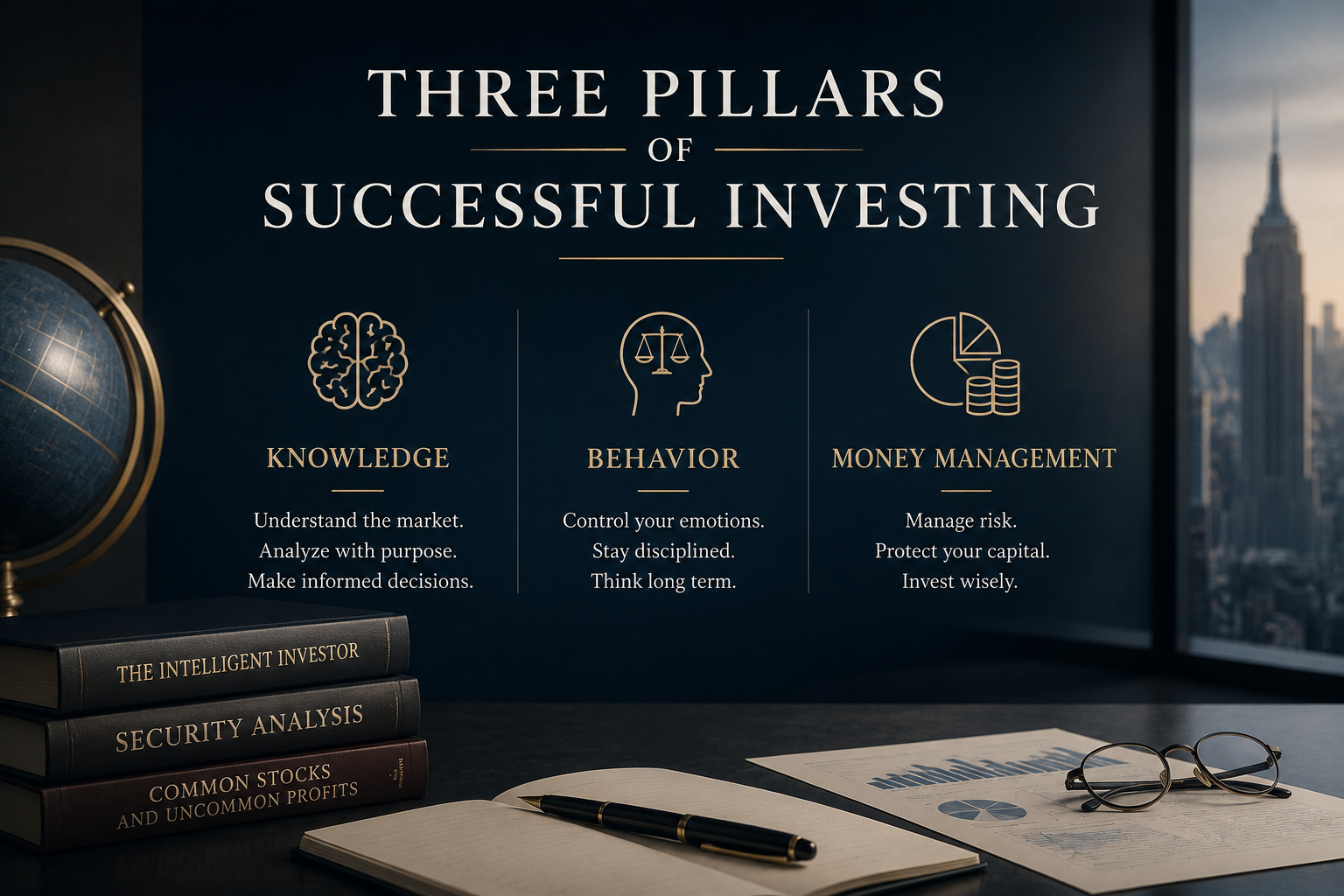
In today’s investment world, various investors, from amateurs to professionals and from individual investors to institutional investors, have been investing their money in funds, stocks, cryptocurrencies, bonds, and similar assets. Some of them are making profits, while others are losing money. Only those who have experienced it know how much seeing red numbers in their wallets hurts. Therefore, every investor must find a strategy that consistently makes them money. We have prepared several touchstones based on knowledge, behavior, and money management to help investors who usually lose money.
Initially, everything needed to become specialized requires knowledge, and finance is no exception. This section includes technical analysis, fundamental analysis, and market settlement analysis. The ability to predict a stock’s movements based on its charts and candlesticks can only be developed through knowledge, and this type of analysis is called technical analysis. Technical analysis helps identify whether a price may rise or fall. As a result, investors can decide when they should enter a position or take a short position. In addition, fundamental analysis refers to reading financial statements and examining factors such as the P/E ratio, P/B ratio, and PEG ratio. What we call “fair value” refers to the average price a stock should have, and it helps us understand the logic of purchasing a stock based on how far it is from its normal price. Finally, it is not sufficient to know only these two types of analysis, so we should also include settlement analysis. Volume is one of the most significant criteria showing investors’ interest in an investment instrument. For example, cash inflow causes prices to increase, unlike cash outflow. In addition, stocks owned by foreign investors tend to appreciate because foreign investors do not want to waste their money; therefore, they invest in reliable companies. In simple terms, knowledge is power when it comes to making the right moves, and it is the first step on the path to mastery.
Secondly, humans are emotional beings, and their emotions can reveal themselves in almost every situation, especially in finance. No matter how well-informed you are, your behavior during volatile stock movements determines your success. “Fear of Missing Out,” or FOMO, means feeling left behind or lacking something, and it is often associated with regret. Investors sometimes sell their stocks hastily to avoid losing money; however, the stock may suddenly rise rapidly. The only solution is to follow a systematic approach. You are not a gambler or a clairvoyant, but a strategist. You must take all possible outcomes into consideration before entering a position. If the price begins to fall, you should accept the failure according to your plan, not according to FOMO. Another form of FOMO occurs when investors sell a stock because they are afraid it will fall. This may reduce the profit they could have earned compared to the profit they originally expected before entering the position. Overall, when investors combine knowledge with proper behavior, their wallets will witness less loss and more profit.
Finally, money management is as necessary as the other factors because it determines how much risk you can take and how much money you should invest in a stock. The greater the risk, the greater the chance of experiencing FOMO, so you must accept only the level of risk that is appropriate for you. Moreover, some stocks can be highly volatile; therefore, investing less money in them can be a logical decision. In addition to risk and capital allocation, money management also includes deciding which investment instruments you should use. For instance, during political crises, you may prefer investing in gold or income-generating funds rather than stocks. Furthermore, you should always set aside some money in case stock prices fall to very low levels, allowing you to take advantage of buying opportunities. As shown above, money management is no less effective than knowledge and behavior.
In conclusion, in an investment world surrounded by price fluctuations, maintaining consistent profits is like preparing your equipment before a battle. We cannot win the fight without knowledge, proper behavior, and effective money management. Don’t forget to sharpen your sword, dear investor!